17 April 2014 - 11h41
Par : Yann Dubois
Catégorie : English, tech
If you need to configure exim4 on a web-server to route outgoing mail but do not want the web server to perform local delivery of e-mail addressed to your own domain name, the simplest way is to configure a “hubbed host” for your local domain. This will route all e-mails to your local domain through an external mail exchanger, and disable local delivery of e-mail to your own domain. And avoids the dreadful “Unrouteable address” error message.
Lire la suite »
Lancez le débat ! - Soyez le premier à commenter ce billet →
23 October 2013 - 00h58
Par : Yann Dubois
Catégorie : English, tech, WordPress
Great news for all users of the very popular (70,000 downloads) legacy plugin for WordPress “YD Recent Posts Widgets with Thumbnails” that I developped in 2009 and maintained up to ca. 2011. This plugin now has an official, brand new successor known as “WP Frontpage News“.

Lire la suite »
Lancez le débat ! - Soyez le premier à commenter ce billet →
20 February 2013 - 23h25
Par : Yann Dubois
Catégorie : tech
 L’univers du développement d’applications mobiles a été bouleversé ces derniers mois par deux faits majeurs qui révolutionnent les technologies et l’économie du secteur. A savoir, d’une part, le décollage du système open-source Android, qui est devenu de loin l’OS pour appareils mobiles (téléphones et tablettes) le plus populaire dans le monde, passant devant l’iOS de l’iPhone. Et d’autre part, la mise au point du système de développement cross-plateforme Phonegap, qui permet non seulement de construire très facilement des petites applications pour mobile en n’utilisant que des technologies “bon marché” longuement éprouvées issues du web (HTML5, CSS3, JavaScript), mais également pour la première fois de créer en une seule fois des applications déployables sur tous les environnements majeurs du marché (Android, iPhone, Blackberry, Windows Mobile, Symbian, WebOs). Suivant la baisse de la complexité de mise au point d’applications mobiles “universelles”, le coût de développement et de maintenance de ces dernières s’est énormément démocratisé. La bonne nouvelle pour les développeurs indépendant, et pour l’écosystème des applications mobiles dans sa globalité, c’est qu’il est enfin possible de faire rentrer leur modèle de développement dans les principes de l’open-source, même s’il faudra encore accepter quelques (douloureuses) compromissions pour déployer du code sur les appareils d’Apple.
Lire la suite »
Commentaires (6)
18 December 2012 - 12h28
Par : gfardoux
Catégorie : Français
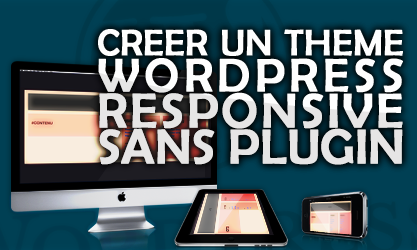
Je ne vais pas vous apprendre ici à créer un thème WordPress, mais juste à le rendre responsive uniquement grâce à une feuille de style différente, et donc… sans plugin 🙂
Lire la suite »
Commentaires (5)
23 August 2012 - 19h57
Par : Yann Dubois
Catégorie : English, tech
The PHP language can be used to remote-control an actual web-browser on a server, to allow server-side scripting of complex web interactions involving for example Javascript of Flash-enabled content. This is a very powerful context, but it is tricky to setup. In addition, a proxy such as Squid can be used to log all http interactions, and can be used as an in-depth traffic analysis or debugging tool. This environment can be used for automated web debugging, continuous integration, unit-testing based web development, non-regression testing, load tests, automated screenshots, etc. Here is a quick setup memo for a running environment under Debian Linux (headless server).
Lire la suite »
Commentaire (1)
20 July 2011 - 11h52
Par : Yann Dubois
Catégorie : WordPress
 Ever since WordPress 3.0 was released, the TwentyTen theme bundled with the distribution has included a feature do dynamically manage the content and organization of menu items from inside the WordPress administration interface. Here’s a step-by-step guide to integrate that feature to any existing WP theme.
Lire la suite »
Lancez le débat ! - Soyez le premier à commenter ce billet →
18 July 2011 - 18h10
Par : Yann Dubois
Catégorie : WordPress
When file permissions are not setup the way it expects, WordPress cannot use the automatic upgrade feature and prompts you for FTP or SFTP credentials to perform any upgrade on a theme, plugin or the core WP files. This happens even when WordPress does have actual write permissions on the files that need to be upgraded.
Lire la suite »
Commentaire (1)